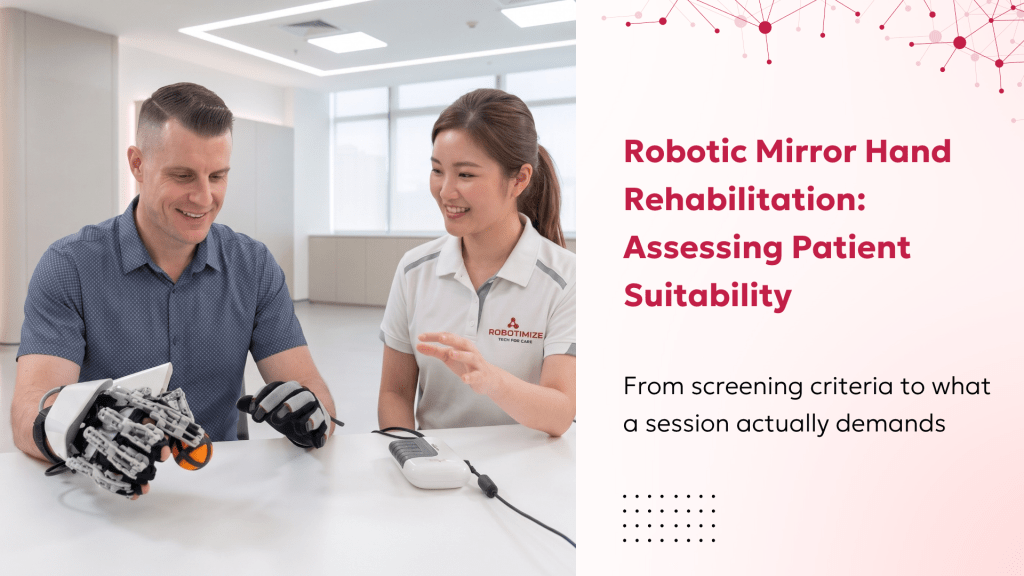
Robotic mirror hand rehabilitation is not appropriate for every patient with reduced hand function. Selecting the right candidates matters for patient safety, for the outcome of the programme, and for whether the equipment earns its place in a clinic. This article sets out the criteria a clinical team should apply.
The Short Answer
Robotic mirror hand rehabilitation suits patients whose hand function has been impaired by a neurological or musculoskeletal injury, who have some early returning movement, whose fingers can still be moved without excessive stiffness, and who are able to take an active part in a session.
A meaningful group of patients falls outside that description, and the exclusions are specific. HandVivante™ MirrorHand is used throughout this article as the reference device for assessing suitability.
What HandVivante™ MirrorHand Is
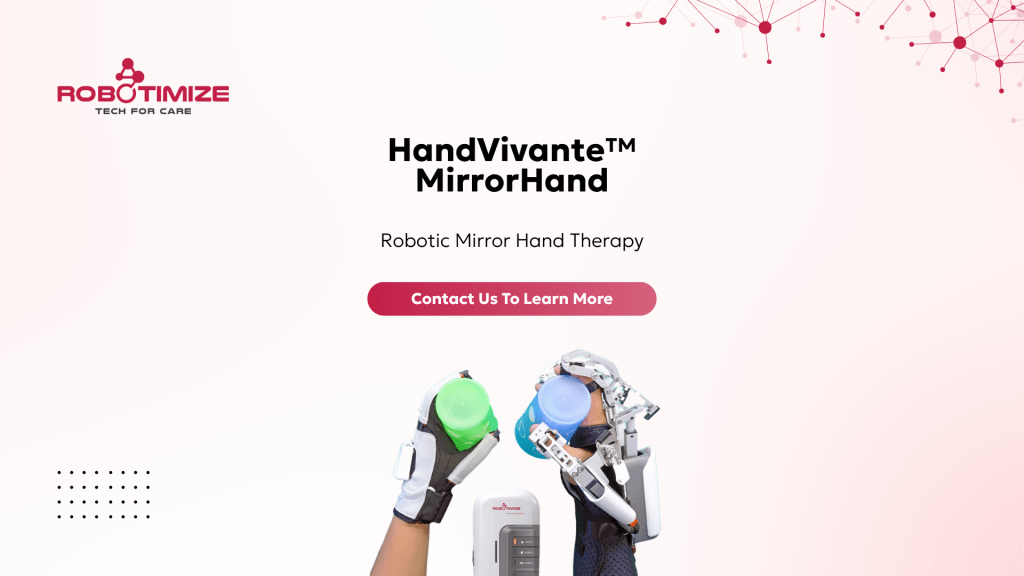
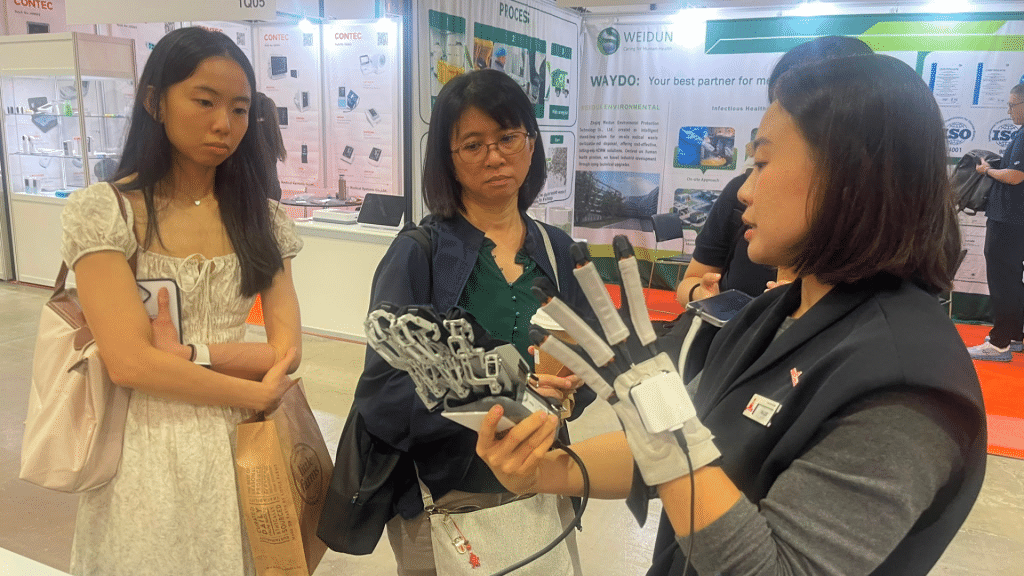
HandVivante™ MirrorHand is a wearable hand exoskeleton. A mechanical frame is fitted over the affected hand, with five finger modules that can each move one finger through flexion and extension. A sensor glove is worn on the unaffected hand, and a control box connects the two.
In mirror-guide mode, the sensor glove detects the movement of the unaffected hand and the exoskeleton reproduces that movement on the affected side. The patient therefore initiates movement in the affected hand using the unaffected one, which is what makes two-handed task practice possible.
The Suitability Criteria
A patient should meet the following conditions before starting treatment.
- Impaired hand motor function arising from neuro-muscular-skeletal injury
- Modified Ashworth Scale below 3
- Mini-Mental State Examination score of 24 or above
- Brunnstrom Recovery Stage of the arm at 2 or above
- A first stroke, at least one month from onset
- Aged between 18 and 90
Gender, height and weight are not restricted.
What Those Criteria Mean in Practice
Brunnstrom stage 2 or above. This is the point at which the earliest movement begins to return after a stroke. A completely flaccid hand with no emerging activity sits below the threshold. Note that there is no upper limit, so patients well into recovery remain within the indication.
Modified Ashworth below 3. Some stiffness is expected and is not a barrier. The limit exists because a device that guides the fingers needs to be able to move them. Above that level, the hand resists the mechanism.
MMSE of 24 or above. Robotic hand training is an active exercise, not a passive one. The patient needs to follow instruction, attend to the affected hand, and report discomfort. That requires intact cognition.
At least one month from onset, with no upper limit. This is worth emphasising, because it is often misread. The device is not restricted to the subacute window.
Who Should Not Use It
Four conditions, diagnosed by a physician, rule the treatment out.
- Poor cognitive ability, such as moderate to severe dementia, or mental illness such as convulsions
- Wrist musculoskeletal disease, such as fracture or tendon rupture, that cannot withstand external force
- Skin disorders, such as pressure sores, trauma or cellulitis
- Cerebellar stroke
The cerebellar exclusion is easily overlooked during screening. The skin condition of the hand also deserves a direct look rather than an assumption, since the device applies straps and mechanical structures across the fingers, palm and wrist.
What A Session Involves
Suitability is also practical. The recommended frequency is once daily, up to a maximum of three sessions a day, at 30 to 40 minutes each, adjusted to the condition of the patient.
Possible side effects include fatigue, mild pain, or skin redness from local indentations where the device contacts the hand. The skin should be examined after the device is removed, and any sign of abrasion reported. A patient who cannot tolerate that contact for a full session, or whose skin marks easily, may need a shorter protocol or a different approach.
The device is operated by a trained doctor, nurse, therapist, other medical personnel, or caregiver, in a hospital or clinic setting. It is not a self-directed home device.
What The Research Adds
A randomised controlled pilot study published in Frontiers in Neurology in 2022 used this device with patients one to six months after a first stroke. Among the whole group, 70 per cent of those receiving robot-assisted bimanual training reached a clinically meaningful improvement on the Fugl-Meyer upper extremity assessment, compared with 22 per cent receiving conventional therapy alone.
More usefully for screening, a subgroup analysis found that patients with more severe upper limb impairment gained more from the robot-assisted training than from conventional therapy, while patients with moderate impairment showed no such difference. The authors suggest a ceiling effect may explain this, since milder patients improve well with conventional therapy alone.
One of the key authors, Prof. Huang Jian-Jia (Charles), PhD, is the designer of the device and the founder of Rehabotics Medical Technology Corporation, a relationship declared in the paper. The trial used a narrower window than the clinical indication, because trial entry criteria are not the same thing as clinical indications.
Where The Technology Fits
Prof. Huang Jian-Jia (Charles), PhD, Founder of Rehabotics Medical Technology Corporation and Assistant Professor at Chang Gung University, and Prof. Yu Cheng Pei, MD, PhD, Director and Attending Physician in the Department of Physical Medicine and Rehabilitation at Chang Gung Memorial Hospital, have both argued that multidisciplinary collaboration decides rehabilitation outcomes. Nurses, social workers, therapists, engineers and researchers all contribute, and technology belongs in that group as one contributor rather than as a replacement for any of them.
Their position is that technology must support clinical judgement, not substitute for it, because patients want the human element. What it adds is specific. Data helps clinicians tailor an intervention. Mechanical support assists the patient while reducing physical strain on the therapist. Immersive and gamified tasks help patients stay with a programme.
The Question Underneath The Criteria
The hardest problem in upper limb rehabilitation is not producing movement in a clinic. It is making that movement transfer into daily life, into holding a cup or signing a name.
That is the real test of suitability. The right candidate is not simply a patient whose fingers a device can move. It is a patient for whom guided, repeated, two-handed practice has a realistic path to becoming independence outside the therapy room.
Sources
- HandVivante™ MirrorHand Wearable Hand Exoskeleton Robotic Device, Product No. HS001, User Guide version 1.2, revised October 2025. Sections 2.1 Intended Use, 2.2 Indication, 2.3 Side Effect, 2.4 Usage Frequency, 2.5 Contraindications, 1.3 Definition, 5.2 Control box operating step.
- Ma D, Li X, Xu Q, Yang F, Feng Y, Wang W, Huang J-J, Pei Y-C, Pan Y. Robot-Assisted Bimanual Training Improves Hand Function in Patients With Subacute Stroke: A Randomized Controlled Pilot Study. Frontiers in Neurology, 2022; 13:884261. doi: 10.3389/fneur.2022.884261. Trial registration ChiCTR1900023989.