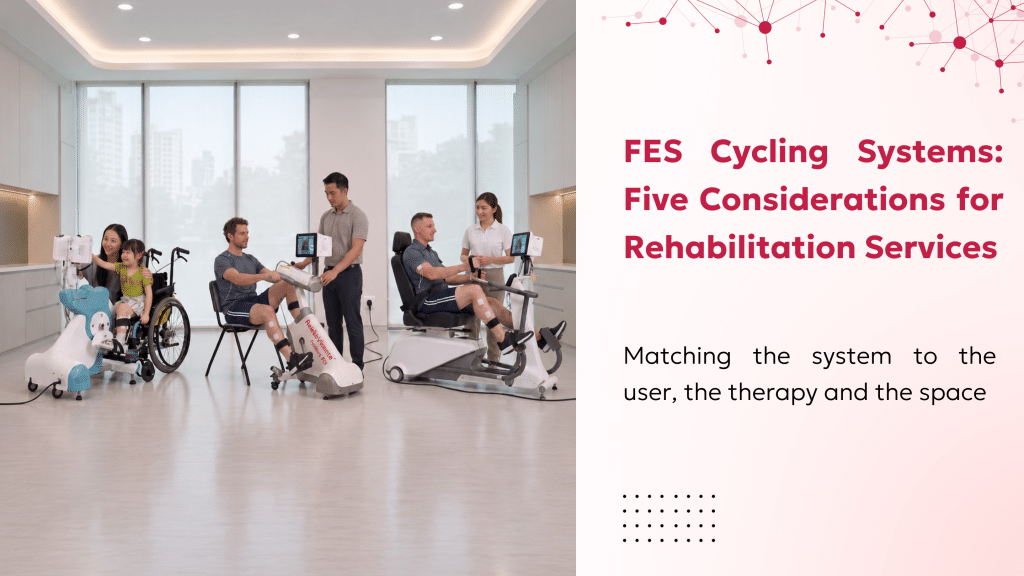
Functional electrical stimulation cycling has moved from a specialist intervention to a standard part of many neurological rehabilitation services, and the range of available systems has widened with it. Bedside units, seated upper limb and lower limb trainers, combined devices and paediatric models all deliver stimulation during a cycling movement, which can make the differences between them difficult to tell from reading the specification sheets alone.
This article explains what FES cycling is, how it differs from conventional electrical stimulation, and the practical considerations that usually decide which configuration suits a given service. The second half works through our own RevitaVivante™ FES Cycling Solution range as an example.
What is FES cycling?
FES cycling combines two interventions that are more often delivered separately. The user is positioned comfortably for cycling, with their feet placed on the pedals or hands on the handles, depending on the device configuration. Multi-channel electrical stimulation is then applied to the relevant muscles, synchronised with the cycling movement.
The stimulation produces muscle contractions in the sequence the movement requires. The electrical stimulation activates the relevant muscles in coordination with the cycling movement, enabling users with limited or absent voluntary muscle control to participate in repetitive, coordinated exercise. Most systems support both passive and active training, and the balance between the two can be adjusted as voluntary control returns along the progress of recovery.
The aims of treatment are to improve or maintain muscle strength, preserve joint mobility, and support the recovery of motor function. FES cycling is used in rehabilitation following:
- Stroke
- Traumatic brain injury
- Spinal cord injury
- Multiple sclerosis
- Cerebral palsy
- Other neurological conditions affecting upper or lower limb function
The suitability of FES cycling for each individual should be assessed by the treating clinician, taking into account their rehabilitation needs, clinical condition and any contraindications.
How does FES cycling differ from conventional electrical stimulation?
Unlike conventional electrical stimulation, FES cycling coordinates stimulation across selected muscle groups in a sequence that produces or assists the cycling movement. The timing of stimulation is synchronised with the movement, allowing the muscles to work together in a coordinated, repetitive pattern.
This is particularly relevant in rehabilitation, where repetitive, task-related movement is an important principle of therapy. FES cycling allows individuals with limited voluntary muscle control to participate in this type of exercise, while also providing the benefits of electrical muscle stimulation.
What determines which FES cycling system suits a service?
When choosing an FES cycling system, it is important to consider not only its stimulation capabilities but also how the equipment will be used in practice. Factors such as the user’s mobility, the type of exercise required and the clinical setting can influence which configuration is most suitable. The following five considerations can help guide the selection.
What are the user’s mobility and positioning needs?
Some individuals may be unable to leave their bed, particularly those in acute care, high-dependency or intensive care settings. Others may use a wheelchair and find transferring to a separate exercise device difficult or impractical.
For individuals who need to remain in bed, a bedside FES cycling system allows therapy to be delivered without transferring them to another position. For wheelchair users, a system that can be used directly from their wheelchair may be more suitable. Those who can transfer safely to a chair or exercise device have a wider range of options.
Understanding the user’s mobility and positioning needs is therefore an important starting point when selecting an appropriate FES cycling system.
Which limbs need to be trained?
FES cycling systems may be designed for upper limb training, lower limb training, or both. A dedicated single-limb device stays configured for one purpose. A combined device covers both limb sets on one frame, and is set up for whichever limbs are being trained in a given session.
What movement pattern does the therapy require?
FES Cycling machines typically employ a circular pedal path, although some employ an elliptical path. Elliptical paths allow the foot to follow a flatter, more elongated movement pattern that more closely resembles movements in walking. They produce different joint movements and ranges of motion. The appropriate choice depends on the rehabilitation objectives and the range of motion the user is able to achieve.
How much space is available, and how many patients train at once?
Floor space is a common concern in rehabilitation departments. A combined upper and lower limb device occupies one footprint rather than two. Separate devices may allow two people to train simultaneously, provided the devices match their respective therapy needs.
The choice therefore involves balancing available space, flexibility in accommodating different users, and the expected demand for each type of therapy.
Does the equipment accommodate the user’s body size and positioning requirements?
FES cycling equipment needs to accommodate the user’s body dimensions and range of movement to allow comfortable and appropriate positioning during exercise. This is particularly important in paediatric rehabilitation, where equipment designed for adults may not be suitable for smaller children. Purpose-built paediatric systems can provide dimensions and adjustments appropriate for younger users.
How these considerations apply: RevitaVivante™ FES cycling range
The considerations above apply to any FES cycling purchase. The range used here as an example is our own. RevitaVivante™ comprises six models, each built around a different use situation: at the bedside or in a seat, for upper limbs, lower limbs or both, with a circular or an elliptical pedal path, and in adult or paediatric dimensions.
Specifications common to the range:
- eight-channel functional electrical stimulation
- stimulation output of 0 to 140 mA, pulse width of 50 to 500 μs, frequency of 10 to 100 Hz
- training speed of 15 to 55 revolutions per minute
- spasm detection with a configurable threshold and protective response, and fatigue detection that adapts intensity during a session
- a touchscreen tablet interface with both Standard and Clinician therapy options
The indications, contraindications, and intended use of each model are stated in its own instructions for use, and should be referred to when assessing whether a device is appropriate for a particular individual.
The range at a glance
Model | Limbs | Configuration | Typically used for |
RevitaVivante™ PreMax FES | Upper and lower | Bedside FES cycling, device brought to the patient | Patients who cannot leave the bed or be transferred safely |
RevitaVivante™ Pro UL FES | Upper only | Seated upper limb FES cycling | Patients needing upper limb training, including patients who remain in their own wheelchair |
RevitaVivante™ Pro LL FES | Lower only | Seated lower limb FES cycling | Patients with lower limb neurological impairment, including patients who remain in their own wheelchair |
RevitaVivante™ ProMax FES | Upper and lower | Seated FES cycling, both limb sets on one device | Mixed cases needing both limb sets where floor space allows only one device |
RevitaVivante™ ProMax 2 FES | Upper and lower | Seated recumbent elliptical FES training | Patients needing reduced knee flexion, a more walking-like movement, or easier entry to the seat |
RevitaVivante™ Ped LL FES | Lower only | Paediatric lower limb FES cycling | Children with cerebral palsy and other paediatric neurological conditions |
Applying the considerations: three examples
An acute ward beginning therapy early. A service treating users in the early stage of recovery, where many cannot yet leave the bed or be transferred safely. Mobility and positioning decide this one, because the device has to come to the user. That points to PreMax, which is positioned at the bedside and adjusts to the user rather than the other way round. Floor space matters less here, since the device moves between beds rather than occupying a therapy room. As users progress to sitting, a seated model becomes the next step.
An outpatient neurorehabilitation centre with one therapy room. Most users arrive by wheelchair and can remain in it, and both upper and lower limb programmes run. Limited floor space is the deciding factor, and a combined device covering both limb sets on one frame answers it, which points to ProMax. If referrals are mostly lower limb, Pro LL keeps the setup simpler. If the programme is oriented toward gait-like movement, toward endurance work at a higher level of effort, or toward users with limited knee flexion, the elliptical path of ProMax 2 becomes the relevant comparison. Where throughput matters more than floor space, two single-limb devices may serve better than one combined unit.
A paediatric rehabilitation service. Body size and positioning lead here. Equipment sized for adults may not allow correct positioning for smaller children, so the question is not which limbs or how much floor space, but whether the frame fits the user. Ped LL is built to paediatric dimensions. A service treating both children and adults will usually need to work through these questions separately for each group.
Working through a specification?
The Robotimize clinical team can discuss your patient population, available space and configuration options, and arrange a demonstration before anything is committed. Get in touch to talk it through.
Contact UsThe six models in detail
RevitaVivante™ PreMax FES
A bedside upper and lower limb FES trainer. The device is brought to the patient rather than the other way round. The leg support angle, the height and the rotation of the trainer section all adjust to the patient position, and a footswitch locks the device once it is in place.
Specification
- upper and lower limb training, circular movement
- eight-channel FES
- bedside positioning with height, angle and rotation adjustment
In practice
This is the only model in the range whose stated indications extend to patients with very reduced or absent walking ability, reduced transfer and standing ability, and patients who are immobile in bed or dependent on a wheelchair for mobility. For those patients the alternative is usually not a different device but a later start to therapy.
Generally suited to patients who cannot leave the bed or cannot be transferred safely, and services that want to begin therapy before mobility returns.
RevitaVivante™ Pro UL FES
A seated upper limb FES cycle. The patient grips the handles, the limbs are secured, and stimulation is synchronised to the circular movement of the upper limb trainer.
Specification
- upper limb training only, circular movement
- eight-channel FES
- the patient may remain in their own wheelchair, secured by the wheelchair fastener
In practice
A dedicated upper limb unit keeps the setup consistent for services where upper limb work dominates, and avoids the configuration changes a combined device requires between patients. The application of use for this model refers specifically to hemiplegia, which reflects the patients the configuration most often serves.
Generally suited to services where most patients need upper limb training, and where the device can stay configured for it.
RevitaVivante™ Pro LL FES
A seated lower limb FES cycle, and the configuration most neurological rehabilitation services consider first. The patient can remain in their own wheelchair, secured to the device by a fastener, or use a stable chair with a backrest and no armrests.
Specification
- lower limb training only, circular movement
- eight-channel FES
- maximum output torque 29 Nm, maximum resistance torque 25 Nm
- wheelchair fastener, with anti-slip matting recommended
In practice
Lower limb configurations cover the widest span of the documented indications for the range, from spinal cord injury and stroke through to multiple sclerosis and other conditions affecting lower limb function. Keeping the patient in their own wheelchair also removes a transfer from the session, which saves staff time and reduces handling risk.
Generally suited to services where lower limb neurological rehabilitation is the main area of work and patients arrive by wheelchair.
RevitaVivante™ ProMax FES
An upper and lower limb FES cycle on a single frame. The trainer converts between upper and lower limb configurations, so one device covers both without a second footprint.
Specification
- upper and lower limb training, circular movement, convertible on one frame
- eight-channel FES
- four training modes: FES cycling, Cycling, FES Independent and Constant Speed
In practice
The practical case for ProMax is floor space. A department with mixed referrals and room for one device gets both limb sets rather than choosing between them. It also offers a fourth training mode, Constant Speed, where the other models in the range offer three.
Generally suited to services with both upper and lower limb referrals and limited floor space.
RevitaVivante™ ProMax 2 FES
The only model in the range that uses an elliptical rather than a circular movement path, in a seated recumbent position. The seat rotates 90 degrees to assist the patient into position.
Specification
- upper and lower limb training, elliptical movement
- eight-channel FES
- seated recumbent position with a seat that rotates for entry
In practice
The elliptical path allows the foot to follow a longer, flatter arc, so the knee moves through less flexion and the pattern is closer to walking. An elliptical path covers more distance per revolution, so at a given resistance the limb does more work, which lends itself to endurance and gait-like training. The appropriate choice depends on the rehabilitation objective and the range of motion the user can achieve.
Generally suited to therapy goals that call for a more walking-like movement, patients with limited knee flexion, or settings where seat entry needs to be as straightforward as possible.
RevitaVivante™ Ped LL FES
A lower limb FES cycle built for paediatric use, sized and configured for children rather than adapted from an adult device.
Specification
- lower limb training only, circular movement, paediatric configuration
- eight-channel FES
- three training modes: FES cycling, Cycling and FES Independent
In practice
The practical difference is positioning. Securing a child correctly to a paediatric frame supports a consistent position from session to session, which is harder to achieve on a device built for adults, and positioning affects both safety and whether the child engages with the session at all.
Generally suited to services treating children with cerebral palsy or other paediatric neurological conditions.
Beyond the equipment: supporting clinical use
The specification is only part of the decision. A system that is difficult to integrate into a programme, or that is out of service while a fault is resolved, is less likely to become part of routine practice. Four areas are worth considering alongside the device itself:
Installation and commissioning. A system needs to be installed, configured to the room and verified before the first session. Robotimize treats commissioning as part of delivery rather than as a separate step.
Clinical training. A therapist who is confident with a device tends to use it. Training the clinical team to that point, and remaining available as staff change, is treated as an ongoing commitment rather than a single handover.
Technical support and service. Downtime on a capital device is lost therapy time. Access to parts and a direct route to someone who knows the equipment matter more across a device lifetime than any single figure on a datasheet.
Continuing clinical input. Requirements change as a service develops. A supplier that stays involved after installation can help a department extend what it does with the equipment it already owns.
In summary
The appropriate configuration depends on the user’s mobility and positioning needs, which limbs are being trained, the movement pattern the therapy requires, the space available, and whether the equipment accommodates the user.
These are clinical and operational judgements rather than specification questions, and they are best worked through with the clinical team that will use the equipment.
If you are working through a specification, the Robotimize team can discuss your patient population, available space and configuration options, and arrange a demonstration so the clinical team can assess the fit directly.
Source documents
- RevitaVivante™ PreMax FES, Instructions for Use, Model RZM-SYC01PL-D08.
- RevitaVivante™ Pro UL FES, Instructions for Use, Model RZM-SYC02-D08.
- RevitaVivante™ Pro LL FES, Instructions for Use, Model RZM-SYC03-D08.
- RevitaVivante™ ProMax FES, Instructions for Use, Model RZM-SYC01-D08, and product brochure.
- RevitaVivante™ ProMax 2 FES, Instructions for Use, Model RZM-SYC04-D08.
- RevitaVivante™ Ped LL FES, Instructions for Use, Model RZM-SYC03E-D08, and product brochure.
- Product direction on the ProMax 2 elliptical configuration supplied by Robotimize, October 2026.